
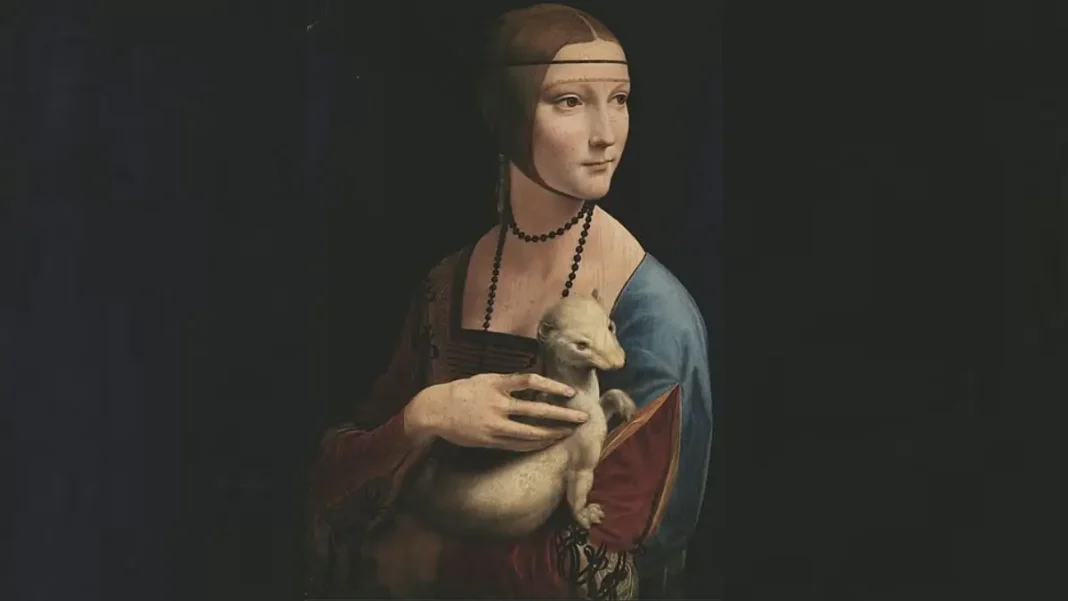
One of the most arresting images in Western art is in the collections of the Czartoryski Museum in Kraków: a young woman turning sharply to her left, cradling a white ermine with a composed, almost uncanny assurance. She does not look to the viewer. She is thinking about something—someone—just out of sight. Leonardo da Vinci painted this moment of inward attention, and invented a new kind of portrait in the process.
The Lady with an Ermine was almost certainly executed in Milan, c. 1489-90, during Leonardo’s long tenure at the court of Ludovico Sforza, Duke of Milan. Almost everyone agrees that the sitter is Cecilia Gallerani, the young mistress of the duke and one of the most noted intellectuals at the Milanese court. Most accounts have her seventeen or eighteen when Leonardo painted her image.
A creature of many meanings
The ermine is not by chance. In Renaissance iconography the ermine was a symbol of purity – the creature was said to prefer death to soiling its white coat. But Leonardo adds meaning with his characteristic density. The Greek word for ermine, galê, is a near pun on Gallerani—the sitter’s own surname. The ermine was also the emblem of Ludovico Sforza himself, who had been invested with the Order of the Ermine by the King of Naples in 1488, and this made the animal a doubly charged cipher, the woman and her patron bound together in one creature.
Leonardo’s treatment of the ermine is what is most extraordinary. The animal is tense, alive, aware. Its small dark eyes fix on the same unseen presence that holds Cecilia’s gaze. The claws grip her forearm with anatomical certainty. It is not a heraldic device – it is an animal with a nervous system and Leonardo knew precisely what that looked like.
The revolution of the head that turns
Before Leonardo , the profile was the dominant mode of portraiture . The sitter was depicted flat from the side , like on a coin or a medal . Lady with an Ermine overturns this convention with muted violence. Cecilia’s body looks one way, her head looks another, her eyes look another again. The outcome is a portrait on three different axes of movement, unified by the illusion of a frozen instant.
Leonardo modelled the face by a technique he called sfumato – the blurring of edges, the suppression of hard outlines in favour of tonal transitions that the eye assembles into form. The skin seems to absorb light, not just reflect it. Infrared reflectography has shown that Leonardo made major alterations to the painting, including a more ornate headdress for Cecilia and an original lighter grey-green background (a later repaint, probably from the 17th century). The ermine itself was added in a revision — X-ray studies suggest an earlier smaller animal, possibly a ferret, was replaced.
The odyssey of a painting: From Milan to Kraków
The painting, acquired in Italy around 1798 and brought to Poland, was sold through several Italian collections before entering the collection of Prince Adam Jerzy Czartoryski in the late eighteenth century. The painting was sold following Cecilia Gallerani. The museum of the Czartoryski family in Kraków became one of the great private collections of Europe. During the Second World War the painting was seized by Nazi forces – Hans Frank, Governor-General of occupied Poland, displayed it in his residence – before being recovered after the war and returned to Poland.
Today it still lies in Kraków, in the collection of the family’s name. It is one of only four portraits among Leonardo’s fewer than twenty surviving paintings, and the only one outside Italy to have stayed in continuous European ownership since the Renaissance. It is, along with the Mona Lisa, the Portrait of Ginevra de’ Benci and La Belle Ferronnière, the definition of what Leonardo thought a painted face could contain: not a likeness, but a mind.
What the portrait invented:
Cecilia Gallerani’s letter to Isabella d’Este (written in 1498, almost a decade after the portrait was painted) is one of the very few contemporary documents that confirm Leonardo’s reputation as a portraitist during his lifetime. Isabella, a great collector and patron herself, had requested the loan of the painting to compare it with works by Giovanni Bellini. Cecilia did as she was told, but reminded her that the portrait had been painted when she was younger, and her looks had changed since then. Leonardo, she suggested, had taken a moment, not a type.
That is exactly what is so strange and contemporary about Lady with an Ermine. The subject is not submitted to our inspection. She ain’t resting. She has turned—perhaps to a voice at the door, perhaps to the Duke himself—and Leonardo has stopped time in the midst of her turning. The frame does not finish the portrait. It reaches into a space we do not see, to a person we will never know. In this it anticipates every subsequent psychological portrait.
Collection note: Lady with an Ermine is in the collection of the Czartoryski Museum, Krakow, Poland. The painting is a Polish national treasure and is subject to export restrictions. Another work, La Belle Ferronnière, also attributed to Leonardo from about the same period in Milan, is in the Louvre, Paris.

Writeic.com is a creative platform dedicated to writers, interview, storytellers, and digital creators who want to inspire the world through words. The authors at Writeic share insights on writing, creativity, storytelling, motivation, success story, and content creation to help readers grow their voice and unlock their creative potential.